As we age, skin naturally undergoes changes. These include the appearance of wrinkles, increased sagging, and a diminished radiance. All of these reflect the deterioration of the skin's structure, a concern many seek to address by finding appropriate ways to care for and rejuvenate their skin.
Currently, medical aesthetic technology is constantly advancing, especially non-surgical facelift procedures. These are considered an effective option for restoring skin smoothness and firmness naturally, without pain or downtime. Therefore, they have become widely popular among those who care about their skin health and appearance.
However, many people may still have questions and wonder at what age is the most suitable to start non-surgical facelift procedures. This article will present guidelines for skin care at different ages, so that you can make confident decisions that are appropriate for your own skin condition.
When is the best time to start a non-surgical facelift?
When starting non-surgical skin tightening treatments, it's important to consider your actual skin condition and problems, rather than just age. However, generally, the ideal age to begin is between 25 and 35, when the body's collagen and elastin production begins to decline. Even if skin problems aren't yet apparent, early skincare is an effective way to slow down the aging process.
Taking care of your skin from a young age helps maintain skin firmness and smoothness for longer, stimulating natural collagen production. This results in stronger skin that ages more slowly, leading to continuously natural-looking results.
For those over 35 years old who are starting to experience sagging skin, deep wrinkles, or changes in facial structure, non-surgical facelifts can also effectively rejuvenate the skin. However, the treatment approach may need to be tailored to the level of skin aging.
Skin aging process
Skin aging process
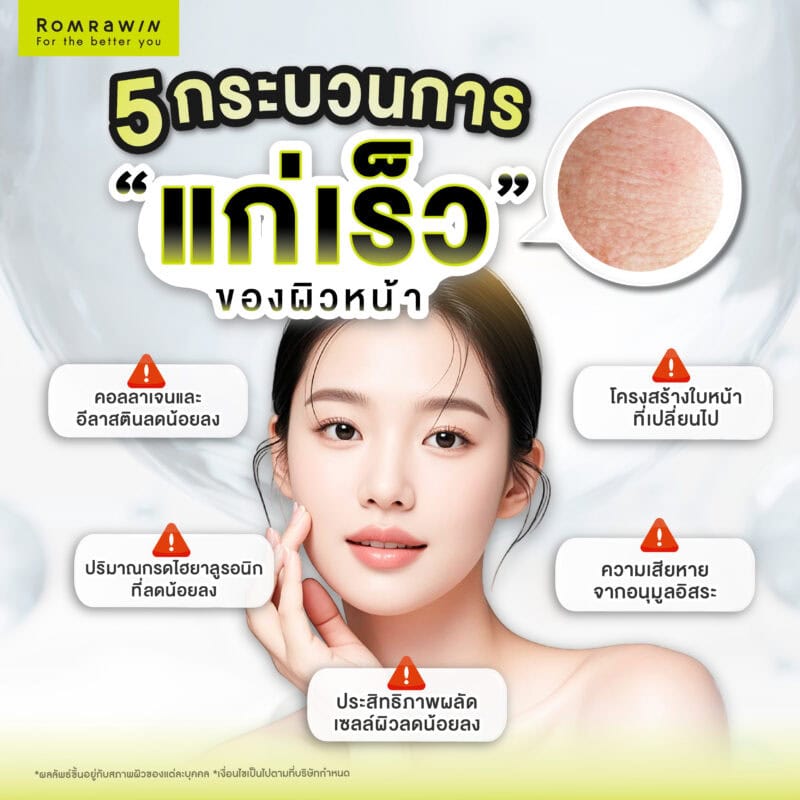
Age-related skin changes are biological processes reflecting the deterioration of the skin's structure at a deeper level. These processes affect both the external appearance, as the skin gradually loses its original properties such as firmness, elasticity, and ability to retain moisture. The mechanisms and factors involved in skin aging are as follows:
The main mechanism of the skin aging process.
The decrease in collagen and elastin.
Collagen and elastin are proteins that play a crucial role in the strength and elasticity of the skin. As the body produces less collagen with age, collagen fibers become brittle, while elastin loses its elasticity. This results in sagging skin, wrinkles, and a loss of overall firmness and structure.
Decreased amount of hyaluronic acid.
Hyaluronic acid acts like the skin's natural sponge, capable of holding many times its weight in water, helping the skin look hydrated, plump, and elastic. However, as we age, the production of hyaluronic acid gradually decreases, leading to dry, cracked, peeling, and less elastic skin.
Reducing the effectiveness of skin cell renewal.
The process of new cell regeneration in the epidermis slows down, resulting in the accumulation of old, damaged skin cells. This leads to dull skin, uneven skin tone, and reduced absorption of skincare products.
Changes in facial structure.
Over time, the structures beneath the skin, such as bone, muscle, and subcutaneous fat, begin to lose volume. Facial bones collapse, muscles weaken, and some fat atrophy, resulting in a change in facial shape, a thinner appearance, and the development of deep wrinkles in areas such as the nasolabial folds, corners of the mouth, and under the eyes.
Damage from free radicals
Free radicals are unstable molecules that can damage proteins, lipids, and DNA within skin cells. Oxidation processes caused by sunlight, pollution, or lifestyle habits accelerate skin aging.
Factors affecting the skin aging process.
Internal factors
Hormonal changes, especially in women during menopause, cause a decrease in estrogen levels, resulting in thinner and drier skin.
Genetics plays a fundamental role in determining the rate of cell aging in each individual, which is why some people have younger-looking skin for longer than others of the same age.
external factors
Sunlight is a major cause of wrinkles, dark spots, and skin cancer because UVA and UVB rays directly damage collagen fibers.
Pollution and dust particles, and toxins in the air, can penetrate the skin and cause chronic inflammation.
Lifestyle habits such as smoking, drinking alcohol, staying up late, chronic stress, and consuming a diet high in sugar or fat are all factors that accelerate premature skin aging.
The early signs of sagging skin.
Wrinkles and deep lines begin to become more prominent.
Deep lines along smile lines, forehead wrinkles, or around the eyes become visible even when the face is at rest and not showing any emotion. This is a result of the deterioration of collagen and elastin fibers in the skin.
The facial contours are not as defined as before.
When skin tissue loses firmness, the jawline, chin, and under the neck appear saggy, giving the face the appearance of a double chin or blurring the facial contours.
Dry, lifeless skin
The skin's natural production of moisture decreases, resulting in dry, dehydrated, and inelastic skin that feels rough and uneven to the touch.
Pores appear noticeably enlarged.
Skin that was once firm and made pores appear smaller will begin to change. As the skin starts to lose its elasticity, pores, especially on the cheeks and nose, will appear wider.
The skin looks dull and the face looks tired.
Even with sufficient sleep, the face may look dull and tired because blood circulation under the skin is reduced, coupled with slower skin cell turnover.
The facial structure undergoes changes.
As subcutaneous fat decreases and gravity exerts its influence, it results in changes to facial shape, such as sunken cheeks or a sagging jawline.
Dark spots, melasma, and freckles become more visible.
Uneven pigmentation, often caused by sun exposure and skin cell degradation, results in dark spots, melasma, or freckles appearing more prominent on the face than in previous ages.
Introducing non-surgical facelift programs tailored to different age groups.
Introducing non-surgical facelift programs tailored to different age groups.
Ages 20 and above
Even though your skin may still look firm at this age, collagen beneath the skin begins to decrease slowly, often without you realizing it. Starting to care for your skin now is a worthwhile investment to delay the signs of aging before the effects become clearly visible in the future.
The recommended non-surgical facelift technologies are as follows:
Oligio uses high-frequency radio waves to tighten the dermis and subcutaneous fat layers, resulting in smoother and brighter skin.
The Ultrafomer MPT delivers focused energy deep into various skin layers, especially the SMAS layer, for lifting and rejuvenating the skin. It features Dual Handpiece technology for both Macro and Micro pulse treatment.
Ages 30 and above
For those aged 30 and above.
As the body produces less and less collagen, the skin begins to show signs of sagging, wrinkles become more pronounced, nasolabial folds deepen, and the jawline loses its definition. Starting collagen rejuvenation at this age can help maintain a youthful appearance for longer.
The recommended non-surgical facelift technologies are as follows:
Ultherapy Prime, a new generation skin tightening treatment developed from Ulthera SPT, delivers focused ultrasound energy deep into the SMAS layer to stimulate new collagen production and provide precise lifting and tightening.
Thermage FLX delivers monopolar RF energy to different layers of the skin to stimulate collagen production, tighten tissue, and restore skin structure for a stronger, healthier complexion.
Morpheus8 uses tiny needles to deliver Microneedling + Fractional RF energy deep into the subcutaneous fat layer, stimulating collagen production and resetting the skin's surface.
Ages 40 and above
As you enter your 40s and beyond, your skin undergoes significant changes, including wrinkles, sagging, deep lines, and loss of subcutaneous fat. This results in a tired and aged appearance. Therefore, skincare at this age requires deeper and more intensive treatments.
The recommended non-surgical facelift technologies are as follows:
Ulthera Prime penetrates the SMAS layer, providing noticeable lifting and tightening results even in cases of more severe problems.
Thermage FLX is suitable for overall facial lifting and tightening, addressing sagging skin across the entire face without being limited to specific areas.
EMFACE is a new technology that stimulates facial muscles (HIFES) and tightens skin with RF in one device.
Morpheus8 is suitable for those with thin skin or skin that needs rejuvenation along with lifting, such as those with significant sagging under the chin.
Features of a non-surgical facelift program.
Ultherapy Prime
Energy
Microfocused Ultrasound with Real-time Visualization (MFU-V)
work
Focused ultrasound energy is delivered to the SMAS (Superficial Musculo-Aponeurotic System) layer, a deep layer of skin structure, stimulating new collagen production and providing deep facial lifting and firming.
Featured
A large Full HD screen allows doctors to see the skin layers in real time. High accuracy and a 20% faster treatment speed reduce treatment time, making it ideal for those with limited time.
result
The skin becomes firmer, the face looks slimmer and more defined, and the jawline is sharper. The results last for 12–18 months.
Thermage FLX
Energy
Monopolar RF high-frequency radio waves
work
It releases energy deep into the dermis and subcutaneous layer, causing collagen fibers to contract and stimulating long-term collagen production.
Featured
The 4.0 mm tip allows for up to 25% faster treatment and up to 33% greater coverage. Suitable for both face and neck, it causes less pain than previous models and features precise temperature control.
result
Skin becomes firmer, fine lines are reduced, and skin appears smoother within 2–3 months, with results lasting approximately 12–16 months.
Ultraformer MPT
Energy
Micro & Macro Focused Ultrasound (MMFU) energy
work
It delivers focused, high-intensity sound waves through various sized tips to different skin layers, including the SMAS layer.
Featured
The specially designed tip allows for more precise energy delivery, enabling focus on specific areas such as the corners of the mouth, chin, and under the eyes.
result
The face is firmer and the skin is smoother. Ideal for those who want gradual and natural-looking results.
Oligo
Energy
Monopolar RF high-frequency radio waves
work
Using heat from RF energy, it stimulates collagen production in the dermis and subcutaneous fat layers. It's suitable for those starting their skincare routine and wanting to tighten their skin.
Featured
It features a cooling and vibration technology to minimize discomfort during the procedure. Additionally, it has a real-time temperature monitoring system that constantly checks the heat delivered to the skin during treatment.
result
Helps tighten pores, smooth skin texture, and revitalize dull skin within 4–8 weeks.
Combining Synchronous RF energy waves with HIFES (High-Intensity Facial Electromagnetic Stimulation) technology.
work
It releases energy to lift and tighten the skin layers, combined with high-intensity electrical waves to stimulate facial muscles, making them stronger and more lifted.
Featured
This treatment delivers energy deep into the muscle layer beyond the SMAS layer, helping to tighten the facial skin for a natural-looking result. It effectively reduces wrinkles by up to 37% and increases facial muscle firmness by up to 30%.
result
The face is more proportionate, the muscles are firmer, and the face looks brighter from the first use.
Morpheus8
Energy
Fractional RF energy waves combined with microneedling technology.
work
Energy is released through tiny needles, specifically penetrating the dermis and down to the subcutaneous fat layer, to stimulate new collagen production and restructure the skin.
Featured
It can be used on the neck, under the chin, or other parts of the body. It's ideal for simultaneous skin rejuvenation and firming, such as reducing pores, acne scars, and sagging skin.
result
Skin is firmer, pores are smaller, and skin looks tighter and smoother within 2–4 weeks.
Where can this be done?
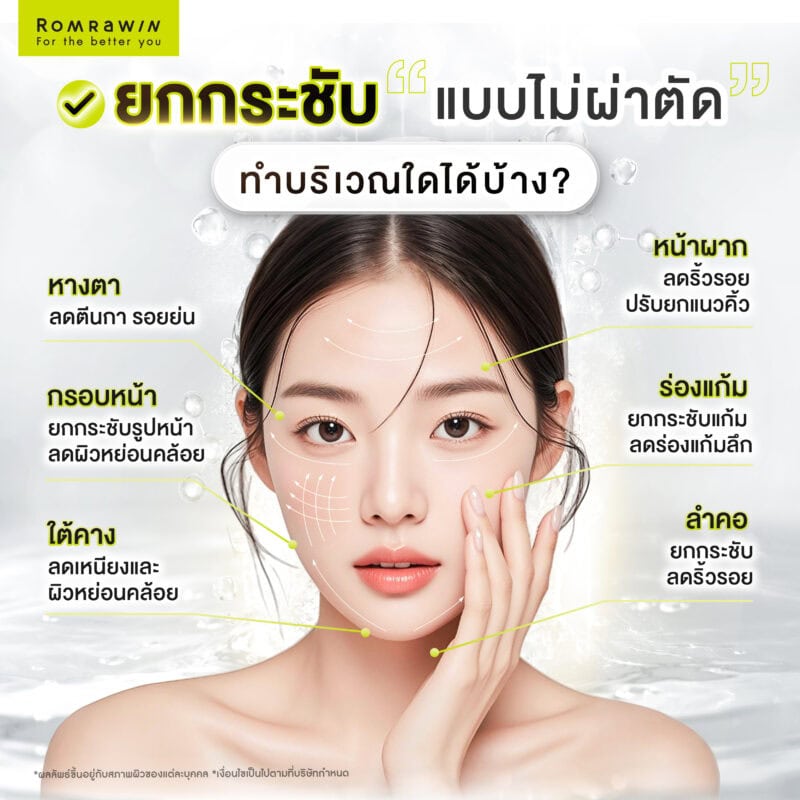
What areas can be treated with non-surgical facelift?
It can be used on the forehead to reduce horizontal wrinkles and lift the eyebrow line.
It can be used on the outer corners of the eyes or under the eyes to reduce crow's feet, wrinkles, and thin skin under the eyes.
It can be used on the nasolabial folds, lifting the cheeks to make them fuller and reducing the depth of the folds.
It can be used on the facial contours, reshaping the face to make it more defined and reducing sagging around the jawline.
It can be used on the area under the chin to reduce double chin and sagging skin in the chin area.
It can be used on the neck to reduce horizontal wrinkles.
It can be used on the inner arm to reduce skin sagging in the upper arm area.
It can be used on the abdominal area to tighten sagging skin after childbirth or weight loss.
It can be used on the thighs and hips, helping to tighten the skin on the thighs and buttocks.
It can be applied to or above the knees to reduce wrinkles around the knees.
What are the benefits of non-surgical facelift?
What are the benefits of non-surgical facelift?
Lift and tighten sagging skin without surgery or downtime.
Reduces wrinkles and deep lines, such as crow's feet, nasolabial folds, and forehead lines.
Lift and reshape the face for a sharper look, including the jawline, chin, and facial contours.
Continuously stimulates collagen production in the skin layers.
Restores skin smoothness and reduces dullness.
Reduce the size of pores and refine the skin texture.
Skin looks younger without the need for fillers or surgery.
The results look natural, not stiff, and leave no scars.
No recovery time is needed after the procedure; you can resume your normal daily activities immediately.
Helps slow down aging and reduce the deterioration of skin structure.
Restore facial muscles to be strong and firm.
Reduce localized fat deposits, such as under the chin, lower cheeks, or double chin, without liposuction.
Rebalances skin tissue for a more even complexion, preventing sagging in specific areas.
It stimulates blood circulation under the skin, making the skin look bright, radiant, and glowing.
It can be safely repeated to enhance results or used for long-term skin care.
Suitable for all skin types, including sensitive, dry, and easily irritated skin.
Suitable for all ages, especially those who begin to see signs of skin aging from the age of 25 and up.
It can be combined with other procedures to enhance comprehensive results.
It's worthwhile in the long run because it helps slow down skin aging.
Who is suitable for non-surgical facelift?
Who is suitable for non-surgical facelift?
Suitable for individuals aged 25–60 who still have reasonably good skin elasticity.
Suitable for those who are starting to show signs of sagging skin, drooping nasolabial folds, and an undefined jawline.
Suitable for those with fine lines or wrinkles in specific areas, such as around the eyes, forehead, and corners of the mouth.
Suitable for those with fat accumulation under the chin or double chin.
Suitable for those with tired-looking faces and dull skin.
Suitable for those with sagging facial skin due to age or lifestyle.
Suitable for those with enlarged pores, uneven skin texture, and who want to rejuvenate their skin without needles.
Suitable for those who do not want surgery or are uncomfortable with a long recovery period.
Suitable for those who want to reshape their face to appear slimmer without surgery.
Suitable for those who want to take care of themselves continuously over the long term.
Suitable for those who want targeted rejuvenation, such as sagging eyelids, drooping corners of the mouth, or a double chin.
Suitable for postpartum mothers who want to restore firmness to their facial or body skin.
Suitable for those who have lost weight rapidly, causing the skin on their body to appear saggy.
Suitable for men or women who want to look better naturally without altering their facial features.
Suitable for those with busy schedules who are unable to undergo surgery or require several days of recovery.
Ideal for those who want to refresh their look and appear younger and more vibrant.
Who is not suitable for non-surgical facelift?
Not suitable for pregnant or breastfeeding women.
Not suitable for individuals with implanted electronic devices, such as pacemakers.
Not suitable for individuals with specific skin conditions requiring treatment, such as psoriasis, eczema, herpes, or severe acne.
Not suitable for individuals with open wounds or fresh injuries in the area to be treated.
Not suitable for individuals with a history of keloid formation.
Not suitable for individuals with blood disorders such as difficulty clotting or low platelet count.
Not suitable for individuals with a history of long-term steroid use.
Not suitable for individuals with heat-sensitive skin or a history of sunburn.
Not suitable for individuals with very little facial fat.
Not suitable for individuals with facial muscle weakness.
Not suitable for individuals with neurological disorders related to muscle function.
Not suitable for those who have recently undergone procedures such as laser skin treatments or facial surgery.
Not suitable for those with very sensitive or easily irritated skin.
Not suitable for individuals with keloid scars on the face or subcutaneous fibrosis that affects uneven energy distribution.
Not suitable for those who have recently received Botox injections within the past 2 weeks.
Not suitable for individuals with immune system disorders, such as SLE.
Not suitable for individuals with a history of photosensitivity or allergic reactions to laser, RF, and ultrasound energy.
Not suitable for individuals with facial muscle movement imbalances, such as hemifacial weakness after nerve inflammation (Bell's palsy).
Not suitable for individuals over 65 years of age with significant sagging and very thin skin.
Preparation before undergoing a non-surgical facelift.
You should inform your doctor if you have any underlying medical conditions.
You should consult a doctor at the clinic to assess your skin condition.
You should get enough rest to allow your body and skin to fully recover.
Avoid using exfoliating products for 2–3 days in advance.
Avoid exposure to strong sunlight or outdoor activities for at least 3 days.
Refrain from waxing, shaving, plucking, or laser treatment in the area to be treated 5–7 days in advance.
Please refrain from wearing makeup on the day of your appointment, especially foundation or sunscreen.
Avoid vigorous facial treatments or massages for about 3-5 days.
Refrain from drinking alcohol and smoking for at least 24–48 hours.
Avoid taking certain vitamin supplements, such as vitamin E and fish oil.
Please refrain from wearing makeup on the day of your appointment, especially foundation or sunscreen.
Post-surgical facelift care.
After the procedure, choose a gentle skincare product.
After the procedure, apply sunscreen with SPF 50 PA+++ regularly every day.
After the procedure, you should drink enough water, at least 1.5–2 liters per day.
After the procedure, you should get enough sleep and rest.
After the procedure, choose a gentle skincare product.
After the procedure, avoid facial massages, exfoliating, or strong treatments for about 5-7 days.
After the procedure, you should refrain from wearing makeup for the first day, especially heavy-coverage cosmetics.
After the procedure, avoid using exfoliating products such as AHA, BHA, Retinol, and Vitamin A for at least 5-7 days.
After the procedure, avoid using steam machines, saunas, or soaking in very hot water for about 1 week.
After the procedure, you should refrain from drinking alcohol and smoking.
After the procedure, avoid touching or rubbing your face vigorously for the first 24–48 hours.
After the procedure, avoid strenuous exercise such as weight training or intense cardio for the first 24–48 hours.
After the procedure, avoid undergoing other procedures immediately. Allow the skin to recover for approximately 2–4 weeks.
How does a non-surgical facelift differ from a surgical facelift?
Non-surgical facelifts are procedures that do not require incisions or scalpels like surgical facelifts. Their advantages include no scarring, no recovery time, and lower risks. They are suitable for those who desire gradual results without major surgery.
Is a non-surgical facelift dangerous?
Generally, it is considered safe if the technology is certified by agencies such as the FDA and performed by experienced clinic doctors, as this allows for precise energy control and close monitoring of results.
At what age should one begin non-surgical facelift procedures?
The recommended age for non-surgical facelift is around 25 years old and up, which is when collagen production in the skin begins to decline. Even if there are no obvious problems yet, starting care early can help delay the signs of aging.
Is a non-surgical facelift painful?
The sensation during the procedure will depend on the technology used and the individual's sensitivity. Some people may feel a slight warmth or tingling sensation under the skin, but overall it is tolerable, and anesthesia is not necessary for some types of technology.
If I have a non-surgical facelift, will my skin return to its original state if I don't continue the treatment?
If treatment is stopped, the results will gradually diminish as the skin naturally ages, but it will not worsen the skin's condition compared to before treatment. Continued non-surgical facelift treatments will help the skin maintain its firmness for longer.
Is it possible to combine non-surgical facelift with other technologies?
Non-surgical facelifts can be performed and combined with other procedures such as filler injections, Botox injections, or laser treatments to enhance effectiveness and comprehensively address the problem. This should always be done under the supervision of a doctor to plan the appropriate treatment.
Do non-surgical facelifts have any side effects?
Possible side effects after a non-surgical facelift are usually temporary, such as redness, slight swelling, or a feeling of tightness, which usually disappear on their own within a few days. However, if any unusual symptoms occur, you should consult a doctor immediately.
Can older people still undergo non-surgical facelifts?
Non-surgical facelifts are also possible, especially if the skin is still reasonably elastic. However, the results may not be as noticeable as in younger people, and may need to be combined with other procedures to achieve better results.
Non-surgical facelifts are a modern and safe option for those who want to maintain youthful-looking skin without pain or downtime. With today's diverse and advanced technologies, patients can choose a treatment approach that effectively suits their skin condition, individual problems, and age group.
However, the results of the treatment will depend on each individual's skin condition, as well as other factors such as age, self-care habits, and the body's response to the energy used. Some may see noticeable results quickly, while others may require a longer period for recovery and further collagen stimulation.
For best results, it is recommended to undergo evaluation and care by a physician and follow their instructions appropriately both before and after the procedure. Consistent and regular skin care is key to maintaining skin firmness, smoothness, and youthful appearance in the long term.